
Prayer beads should not have to be damaged to establish their value. Hot needles, acetone and scratch tests can harm the beads or finish, create fumes and still fail to give a reliable answer. A better review combines the item's recorded history, appearance and construction, with laboratory examination when its value warrants it.
Confirm the declared material
Ask whether the item is natural amber, pressed amber, treated amber or another material. The Arabic market name anbar can be used loosely, so request a precise written description.
Use a visual inspection
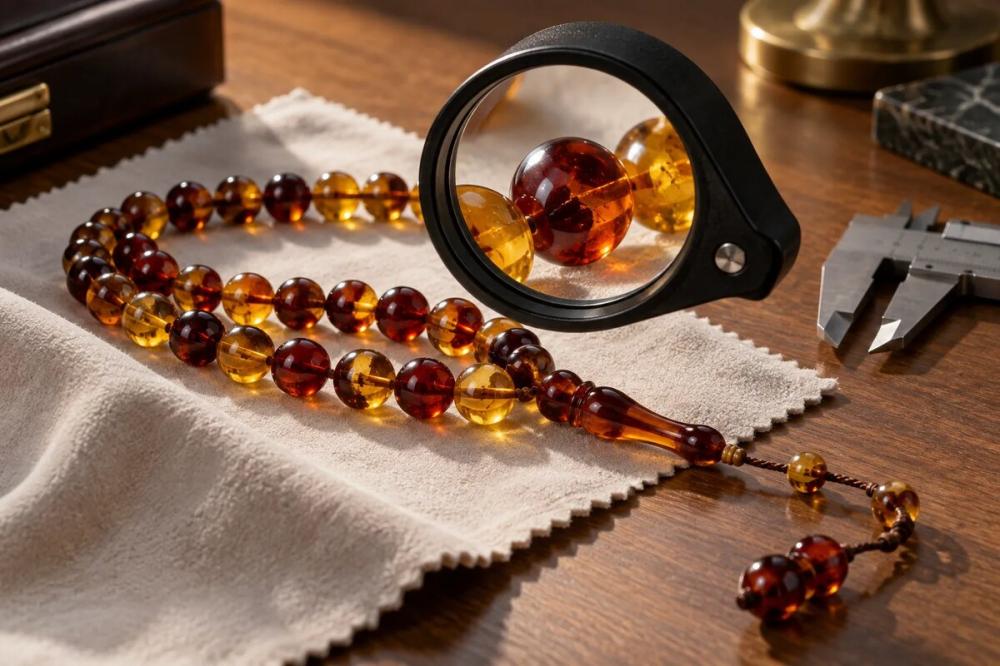
A loupe and angled lighting can reveal polish marks, drill holes, cracks, bubbles and variation. These observations help describe condition, but no single visible feature is a conclusive authenticity test.
Record size and weight
Note bead count, dimensions, total weight and, if available, the weight of accessories. These are useful identifying details, not independent proof of authenticity.
Inspect construction
Examine hole edges, dividers, the terminal piece and cord tension. The quality of a finished strand is not determined by its bead material alone.
Avoid destructive experiments
Do not use flame, hot needles, solvents or scratching. Floating and static-electricity demonstrations can also mislead and should not be treated as decisive identification methods.
When a laboratory is useful
For a high-value purchase, ask a recognised gemmological laboratory about suitable examination. Read what the report identifies and any limitations concerning treatments or construction; do not assume it proves every seller claim.
What a specialist review adds
A useful review starts by defining the question: material identity, treatment, or correspondence with an earlier report. Ask the specialist what can be established without damage and how the report is tied to the offered strand. A laboratory name does not replace reading the conclusion, and a report for another piece does not apply because the colours look similar. For a valuable purchase, make clarity of identity part of the agreement before payment rather than a late request after use.
What to do with an inconclusive result
Available details may not give a final answer. That calls for less confidence in the claim, not an invented explanation. Request clarification, choose a better-recorded piece or postpone the decision. You can appreciate a design while its material identity remains uncertain, but that uncertainty should affect how it is described and valued. Do not pass on a definite claim when gifting or reselling it unless you have the supporting evidence. Trust depends on careful language as well as careful handling.
Care for the complete strand
Follow the product’s care instructions and use a soft cloth for routine dust removal. Protect amber from heat, harsh chemicals and direct perfume contact, and store the strand away from items that could scratch it. Check the cord and fittings before use; seek specialist help for damage or deeper cleaning.
Compare the description with the actual piece
When exploring OUDNNA’s yellow amber prayer beads or amber stone prayer beads, read the current material description and dimensions, then ask for information about the offered piece. Colour and a product name are starting points for questions, not a substitute for identification.
Common questions
Does a smell produced by rubbing prove amber?
No. A smell observation alone is insufficient to identify the material.
Preserve the piece while you learn about it
Protect the strand while you investigate it. A useful test adds evidence without taking away part of a bead or damaging its surface.
For the next part of your choice, read choosing prayer beads by size and weight and our guide to natural, pressed and treated amber beads.
Background and supporting guidance: GIA description of amber; amber care guidance. These sources do not certify individual store products.